 Skyris Newsletter |
No. 1 · Fri, Oct 16, 2026 |
|
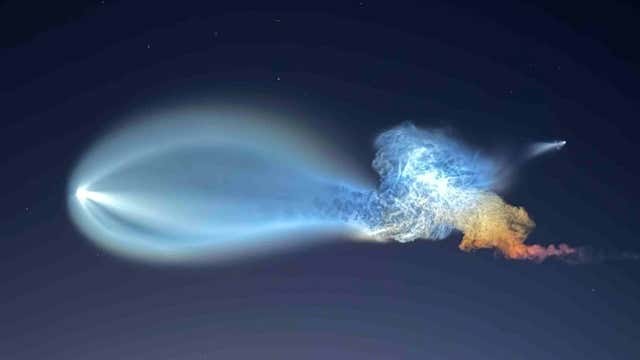 |
| Reader photo by Facebook, Falcon 9 launch |
|
|
This week
Halley's debris arrives once the Moon has gone
The Orionids peak on Thursday morning, and this year the Moon, 83% lit, sets at 3:12 am, which leaves a dark stretch before dawn twilight begins at 5:43 am. Before that, the week's crescent builds to first quarter on Sunday, with Saturn low in the east and Mars and Jupiter high before dawn.
|
|
Moon
Waxing crescent to first quarter
Roughly a third lit tonight. First quarter falls Sunday at 12:13 pm, and the Moon is 88% lit by Thursday evening.
|
Evening sky
Saturn rising in the east
Magnitude 0.3 in Cetus, listed at 14° up in the east on Friday evening. Full darkness begins at 7:45 pm.
|
Pre-dawn sky
Mars and Jupiter in the southeast
Mars (magnitude 1, in Cancer) is listed at 58° up and Jupiter (magnitude -1.9, in Leo) at 48° up. Dawn twilight begins at 5:38 am.
|
|
|
|
|
Many people took to social media Tuesday showing pictures just like the one in the headline. Some guessed it was a UFO. Others thought it was a missile or something strange in the clouds.
It was a rocket launch. A SpaceX Falcon 9 lifted off from Cape Canaveral at 6:33 a.m. Eastern, carrying supplies to the International Space Station.
With all the technology we carry around today, it’s amazing how many people didn’t know what they were looking at. But launches from Florida happen so often now that they barely make the news, and most people never see one.
What made Tuesday’s so striking was the timing. It was still dark on the ground, but the rocket climbed high enough to catch the sunlight before sunrise. The sun lit up the exhaust as it spread out in the thin air, making that glowing “jellyfish” shape you saw in everyone’s photos. There were even reports and pictures of people being able to see it as far west as Kentucky!
Launches right before sunrise or right after sunset are the ones worth watching for. When one is coming up, Skyris will let you know in Friday’s issue, with the time and which way to look.
And if you got a picture of Tuesday’s launch, send it in. It might end up as the header of a future issue.
|
|
|
|
Best night: Saturday, clear from 8 pm to 5:39 am. Sunday looks about as good, clear from 8 pm to 5:40 am. Monday and Tuesday look cloudy, though confidence there is only fair. Wednesday night into Thursday shows clear skies for the Orionids, but that is low confidence, so check again closer to the night. The first-quarter moon sets around midnight; save faint targets for after it goes down.
|
Fri

rain
|
Sat

all night
|
Sun
all night
|
Mon

10p–4a
|
Tue

|
Wed

all night
|
Thu
|
For the New York City area · later nights may change · Open-Meteo.com
|
|
|
Fri 16 onward, evening |
Saturn climbs out of the east
Saturn rose at 5:48 pm and is listed at 14° up in the east on Friday evening, shining at magnitude 0.3. It sits in Cetus, a dim constellation with few bright stars, so the planet stands out as a steady, slightly yellow point with little nearby to compete. It stays up until 6:02 am Saturday morning.
|
Sat 17, before dawn |
Mars and Jupiter, high in the southeast
Mars rises at 12:56 am and Jupiter at 1:57 am, and by the pre-dawn hours they are well up in the southeast. Mars is listed at 58° up, at magnitude 1 in Cancer, and Jupiter at 48° up, at magnitude -1.9 in Leo. Jupiter is the brighter by a wide margin, while Mars shows a distinctly orange tint beside it.
|
Sun 18, evening |
First quarter Moon in binoculars
First quarter arrives at 12:13 pm Sunday, so by evening the Moon is 54% lit. This is the best phase for binoculars: the terminator is at its most informative, and low sunlight throws long shadows across crater walls and the edges of the maria. Steady the binoculars against a wall or a car roof and follow the line between day and night.
|
Wed 21 → Thu 22, after 3:15 am |
Orionids peak
The shower peaks on the night of Wednesday into Thursday at up to 20 meteors an hour under dark skies, and fewer from town. The Moon, 83% lit, sets at 3:12 am, so the useful window runs from after 3:15 am until dawn twilight begins at 5:43 am. Meteors trace back to a radiant in Orion but appear all over the sky; the longer ones are often those furthest from it.
|
|
|
The story
The comet that never lived to see its return
Every Orionid is a piece of Halley's Comet, a grain shed during one of its many passes by the Sun and now vaporising in our upper atmosphere. Earth does not meet the comet itself. It meets the long trail of debris the comet has left along its orbit. We cross that orbit twice a year, which is why Halley supplies two showers: the Orionids in October and the Eta Aquariids in spring. Edmond Halley did not discover the comet that bears his name. He worked out that the bright comets recorded at roughly regular intervals were one object on a long ellipse, and he predicted its return. He died before it came back, so he never saw his prediction confirmed. It was the first comet shown to be periodic, and an early demonstration that Newtonian gravity could be applied to the wider solar system. The Orionids are modest because the stream is old and spread thin. Debris shed over many orbits has been stretched along and across the comet's path, so Earth passes through a diffuse band rather than a dense filament. That is why the peak is broad and the hourly rate is low. The compensation is speed: the particles hit the atmosphere head-on, and Orionids are among the faster meteors, often bright and sometimes leaving a faint glowing train after the streak fades.
|
|
|
Shoot it: The Orionids, as a meteor timelapse
|
|
Meteors are unpredictable, so the efficient method is continuous shooting from after moonset until twilight, then sorting the frames afterward. Aim a wide lens at the southeast, where Jupiter and Mars give the frame an anchor, and include some foreground for scale. |
|
Camera settings
Lens |
24mm on full frame
Use about 16mm on APS-C for a similar field.
|
Aperture |
f/2.8 or wider
Open up as far as the lens stays sharp.
|
ISO |
3200
Drop to 1600 if any sky glow brightens the frames.
|
Shutter |
15 s
The 500 rule gives about 20 s at 24mm; 15 s keeps stars tighter.
|
Focus |
Manual, at infinity
Zoom in on Jupiter in live view, then lock focus.
|
White balance |
3800–4200 K
Fixed, so the frames match across the sequence.
|
Interval |
1 s between exposures
Intervalometer or built-in interval timer.
|
Frames |
300+ in RAW
About 16 s per frame, so 300 frames is around 80 minutes.
|
|
|
|
With a phone
A phone will not catch many meteors, but it can still record some. Mount it on a tripod, use Night mode or a manual app at the longest exposure it allows, and shoot a series pointed at the southeast sky. Turn off the flash, and review the frames for streaks afterward.
|
|
|
→ Don't aim at the radiant. Meteors near the radiant are foreshortened. A frame 40–60° away from Orion shows longer, more dramatic trails. → Keep the lens clear. Dew ends more meteor sessions than clouds. A lens heater strap or a dew shield keeps the front element clear over a long run. → Sort, then composite. Cull the frames that contain meteors, then stack them with a lighten blend over one sky frame in Photoshop or a tool such as Sequator, giving a single image of the night's meteors. |
|
|
|
Got a great shot of the night sky?
Each week we pick a reader’s photo for the top of the next issue, credited to you, from Milky Way panoramas to a phone shot of the Moon over your street.
|
|
|
Always watch for clear skies.
Questions or ideas? Just reply to this email, or write to us.
Written for northern-hemisphere skies. All times are Eastern Time.
You’re getting this because you signed up for the Skyris Newsletter.
|
|